Success in today’s digital world is determined by your ability to use data effectively. Businesses are using artificial intelligence (AI) and machine learning (ML) to transform data into useful insights, more intelligent choices, and improved consumer experiences.
Businesses can now automate procedures, forecast results, and scale more quickly independently. This tutorial will teach you what artificial intelligence and machine learning are, why they are important, and how to use them in your company.
What is Artificial Intelligence (AI)?
Artificial intelligence (AI) refers to systems and machines capable of carrying out tasks that would normally require human intelligence. These skills include decision-making, problem-solving, language comprehension, and pattern detection.
Businesses are already utilizing chatbots to help consumers and AI-powered solutions to increase productivity. AI is a key factor of digital transformation, helping companies streamline operations and provide better results for their customers.
What is Machine Learning (ML)?
Machine learning is a subset of AI that enables computers to learn from data and improve over time without the need for explicit programming. ML algorithms evaluate patterns and produce data-driven predictions rather than any fixed rules.
For example, ML can assist firms in predicting client behavior, detecting fraud, and recommending products based on previous purchases.
AI vs. Machine Learning: What’s the Difference?
Machine learning is a part of artificial intelligence (AI), which is a larger concept.
- AI focuses on developing intelligent systems. While machine learning (ML) focuses on learning from data and increasing performance
Consider AI as the objective (smart systems) and ML as the technique (learning from data to reach that goal).
Why AI and ML Matter for Businesses
AI and machine learning are more than trends; they are powerful tools that can revolutionize the way businesses operate.
1. Better Decision Making
To find trends and insights that people might overlook, machine learning (ML) examines vast amounts of data. This allows businesses to make better, data-driven decisions.
2. Improved Customer Experience
AI-powered chatbots help businesses understand their customers better.
3. Increased Efficiency
The automation of repetitive processes saves time and reduces operational costs. This allows teams to concentrate on more strategic projects.
4. Predictive Capabilities
Businesses can use machine learning to estimate demand, trends, and risk, which helps them be ready for the future.
5. Competitive Advantage
Companies that use AI early get a competitive advantage by increasing efficiency and innovation.
Top 5 Key Applications of AI and ML in Business
Artificial Intelligence (AI) and Machine Learning (ML) are revolutionizing how different aspects of an organization run by making processes smarter, faster, and more data-driven.
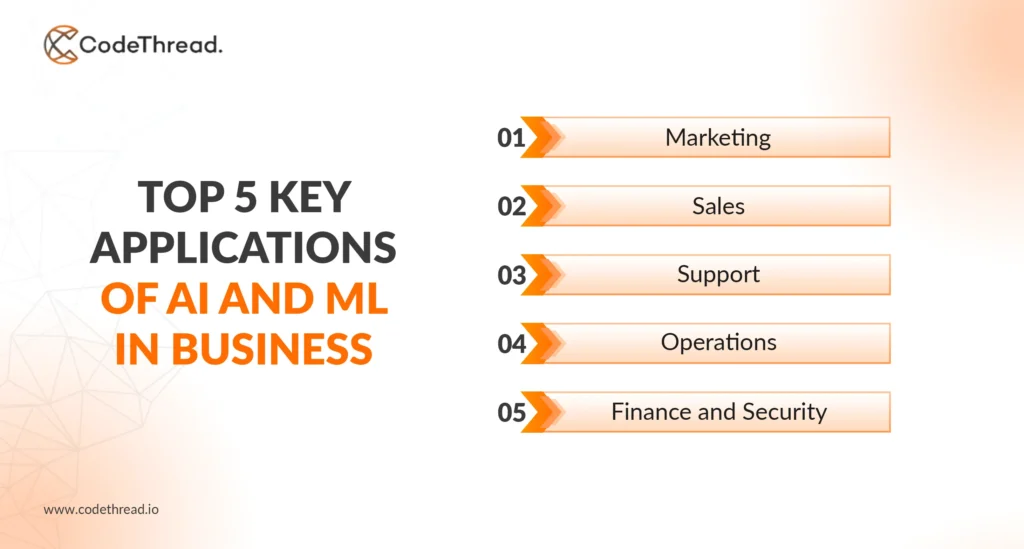
1. Marketing
AI and ML enable organizations to create personalized experiences, segment audiences based on behavior, and optimize ad campaigns for higher engagement and conversions.
2. Sales
Businesses may increase conversion rates by using AI and ML to find high-quality leads, forecast sales trends, and obtain deeper consumer insights.
3. Support
AI-powered chatbots mixed with machine learning enable organizations to deliver instant, 24/7 help while constantly learning from interactions to better responses.
4. Operations
AI and machine learning improve operations by automating monotonous jobs, managing supply chains, and forecasting demand via data analysis.
5. Finance & Security
AI and machine learning (ML) improve fraud detection and risk analysis and allow for precise financial predictions based on trends and past data.
Challenges Businesses Face with AI and ML
Despite its advantages, using AI is not without challenges:
- High initial investment
- Data quality problems
- Lack of skilled professionals
- Integration with existing systems.
- Security and privacy issues
Additionally, a lot of small organizations have trouble figuring out where to begin or how to scale AI solutions properly.
Best Practices for Implementing AI in Your Business
To properly implement AI and ML, companies need to follow recommended practices:
1. Start Small
Start with a single use case, such as marketing personalization or automated customer service.
2. Focus on Data
Make sure your information is precise, relevant, and structured.
3. Choose the Right Tools
Use scalable platforms and technologies that are compatible with your business objectives.
4. Work with Experts
Collaboration with experienced companies or AI consultants might help to decrease risks and accelerate deployment.
5. Monitor and Improve
Monitor performance continuously and improve your models to achieve better outcomes.
The Future of AI and ML in Business
AI and ML are evolving rapidly. From generative AI to advanced automation, these technologies will continue to reshape industries.
Businesses that adopt AI today will be better positioned to adapt to future changes, improve efficiency, and unlock new growth opportunities.
Conclusion
Artificial intelligence and machine learning are revolutionizing company operations. These technologies provide various advantages, such as enhancing the client experience and enabling more intelligent decision-making.Despite the difficulties, companies can successfully incorporate AI into their operations with the correct plan and method. Whether you’re a startup or an established company, now is the moment to investigate how AI and machine learning may help your business to grow.