 maira asif
AI Development Cost Guide: Budgeting for Your Project
AI is transforming the way businesses operate, engage with customers, process data, and create new products. There are…

We transform complex ideas into simple, powerful digital solutions that scale with your business, helping you innovate faster, operate smarter, and deliver meaningful experiences
Businesses are using AI for everything from predicting demand and detecting fraud to generating content and automating customer interactions. It is no longer just a future technology; it is already shaping how businesses operate. As adoption grows, one question comes up often: should a business use generative AI or traditional AI? Although both technologies use AI, they serve different purposes.
Traditional AI analyzes existing data, identifies patterns, and uses them to make predictions or classify information. On the other hand, generative AI creates new content, such as text, images, audio, and code. Understanding this difference helps businesses choose the right solution and get better returns on their AI investments. It shapes which problems each technology can solve, what kind of ROI to expect, and how to build a realistic AI strategy.
Traditional AI, sometimes called “narrow AI” or “discriminative AI,” refers to systems trained to perform specific tasks. These models analyze data, make predictions, and classify information based on what they have learned.
Traditional AI has powered business operations for over a decade. Common traditional AI use cases include:
Traditional AI can analyze the patterns seen in emails and sort them into spam or legitimate.
Traditional AI can be used to streamline business processes, including finding the most efficient route for deliveries, adjusting prices according to demand, and creating staff schedules.
Traditional AI can detect unusual patterns to identify fraudulent transactions, potential network security threats, or manufacturing defects.
These systems are usually trained on structured and labeled datasets for a particular task. When a business has a clearly defined problem and has enough historical data to support it, then traditional artificial intelligence is the most effective approach.
Generative AI creates new content, such as text, images, audio, code, and video, by learning patterns from large amounts of data. Unlike traditional AI, which mainly analyzes information to make predictions or classifications, generative AI produces new content and responses based on the information it has learned.
Common use cases of generative AI include:
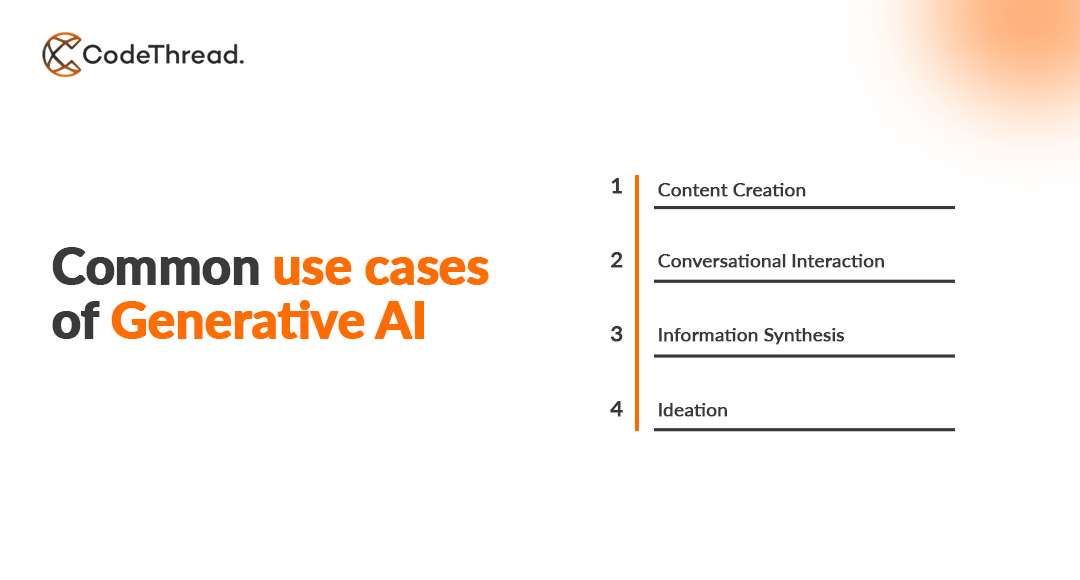
Generative AI can draft emails, write code, create marketing copy, and produce other types of digital content.
Generative AI can create chatbots and virtual assistants that handle open-ended questions and provide responses.
Generative AI can combine information from multiple sources to summarize complex information and produce useful reports, answers, or recommendations.
Generative AI can serve as an inspiration tool for creative and business tasks, providing initial ideas and drafts.
When generative AI is trained on a wide range of information, it can perform multiple tasks, like composing a legal memo, summarizing a meeting, or troubleshooting software.
The main difference is what they are designed to produce. Traditional AI focuses on analyzing data or making predictions, while generative AI generates or manipulates information.
| Feature | Traditional AI | Generative AI |
|---|---|---|
| Accuracy | Usually more predictable for specific tasks | Can produce inaccurate or unexpected outputs |
| Flexibility | Designed for specific tasks | Can handle a wide range of tasks |
| Cost | Can be more cost-efficient for focused tasks | Can involve higher usage and implementation costs |
| Complexity | Often simpler for a defined use case | Can require more complex integration and governance |
| Creativity | Limited content-generation ability | Can generate new content and ideas |
| Data requirements | Works well with relevant historical data | Often benefits from large datasets and pre-trained models |
| Risk and control | Easier to control for defined outputs | Requires stronger monitoring and governance |
The most common business mistake is choosing trendy technology instead of the technology you need. When the objective is to make predictions, categorize data, or detect patterns, traditional AI is often a better fit.
Generative AI may be more appropriate when the task involves generating content, responses, or other open-ended outputs. In most cases, using both is the best option. For instance, a traditional AI system can identify a high-risk insurance claim; a generative AI system can create a report of key findings for a human adjuster to review.
The decision should be based on business goals in the end. The goal could be to reduce costs, to boost employee productivity, to improve customer satisfaction, or to accelerate the process, and the right approach to AI development should be chosen according to the problem that needs to be solved.
The best AI strategy is not always choosing between traditional and generative AI. In many businesses, they can both work together. Traditional AI can handle prediction, classification, and optimization, while generative AI can support communication, content creation, and knowledge-based tasks.
When deciding whether to use an AI system, businesses should consider their objectives, current processes, and available data. Working with a trusted company can help identify realistic opportunities, develop a clear plan, and provide guidance on implementation aligned with the business’s actual needs. AI must focus on solving the right problem and delivering measurable results, not just on using it.
maira asif
AI is transforming the way businesses operate, engage with customers, process data, and create new products. There are…
 maira asif
Learn how to choose the right AI development company by evaluating experience, AI development services, technical expertise, pricing,…
 maira asif
INTRODUCTION As we all know, technology is evolving faster than ever, which constantly increases pressure on businesses to…