
 maira asif
What Is an Embedded AI Engineer? Roles, Skills, and Benefits
Many businesses want to use AI, but finding the right people to build and manage it isn’t always…

We transform complex ideas into simple, powerful digital solutions that scale with your business, helping you innovate faster, operate smarter, and deliver meaningful experiences
AI is reshaping software development, testing, and maintenance. Businesses are no longer using AI just for simple tasks. They are increasingly integrating it into their products, development processes, and daily operations.
This transformation has introduced a new need for engineers who can incorporate AI into their daily workflows. In software development, an AI-native engineer utilizes AI tools and technologies to create applications, resolve technical issues, and optimize teamwork.
So, what is an AI-native experience, and how is it different from the traditional software engineering experience?
An AI-native engineer is a software engineer who uses AI in the development process from the start. They consistently use AI tools throughout the software development lifecycle, including coding, code reviews, testing, debugging, and building AI-driven applications.
These engineers understand how to work with AI coding assistants, large language models (LLMs), and AI development tools while applying their own technical judgment.
For example, an AI-native engineer might use AI to generate initial code, identify potential errors, write tests, or explore different approaches to a technical problem.
They then review the results, make necessary changes, and ensure the final solution meets the project’s requirements. It’s not about using AI to do everything. It’s about merging the skills of engineers with AI to make software development more effective.
An AI-native engineer’s responsibilities can vary depending on the project and business requirements. However, their work often involves the following activities:
Apply artificial intelligence at every phase of software development. AI-native engineers use AI tools to support different stages of development. These tools can be used to generate code, document, explain, and detect errors.
Engineers can leverage AI to explore solutions and save time on repetitive development tasks, rather than tackling each task individually.
These engineers also create software with AI functions. This may involve integrating large language models, developing AI agents, or creating applications that use machine learning.
For example, a business might need an AI assistant that answers customer questions using information from its internal knowledge base. An AI-native engineer can assist in creating the application, linking the appropriate data sources, and testing the assistant’s responses.
AI-generated code isn’t always correct, secure, or suitable for production. Before using the code, engineers should know what the code does.
An AI-native engineer reviews generated code, checks for errors, evaluates security risks, and tests whether the solution works as expected.
This technical judgment is critical, as the AI tools can yield inaccurate results or miss critical requirements.
AI-native engineers seek ways to enhance the performance of software teams. They may use AI to assist with testing, documentation, code reviews, debugging, or other development activities. They can also assist teams in determining the areas where AI tools are necessary and where human skills are still needed.
Being an AI-native engineer requires more than knowing how to use AI tools. Strong software engineering fundamentals remain essential.
Some important skills include:
Communication and collaboration also matter. AI-native engineers often work with product managers, designers, and other developers to understand requirements and deliver solutions that meet business needs.
Both roles require strong software development knowledge. The main difference is how AI is incorporated into their work.
| Factor | AI-Native Engineer | Traditional Software Engineer |
| Development approach | Uses AI throughout the development process | May rely more heavily on conventional development methods |
| Coding | Combines manual coding with AI-assisted development | Primarily writes and maintains code directly |
| AI tools | Regularly uses AI coding assistants and related tools | May use AI tools occasionally or as needed |
| Problem-solving | Uses AI to explore solutions alongside technical judgment | Often relies on established development approaches |
| AI application development | May specialize in building AI-powered products | Can develop AI applications with relevant experience |
These roles aren’t mutually exclusive. Traditional software engineers can adopt AI-native practices, and experienced AI-native engineers still need strong conventional programming skills.
The impact of AI-native engineering becomes significant when companies seek to create software, enhance products, and meet evolving technical demands.
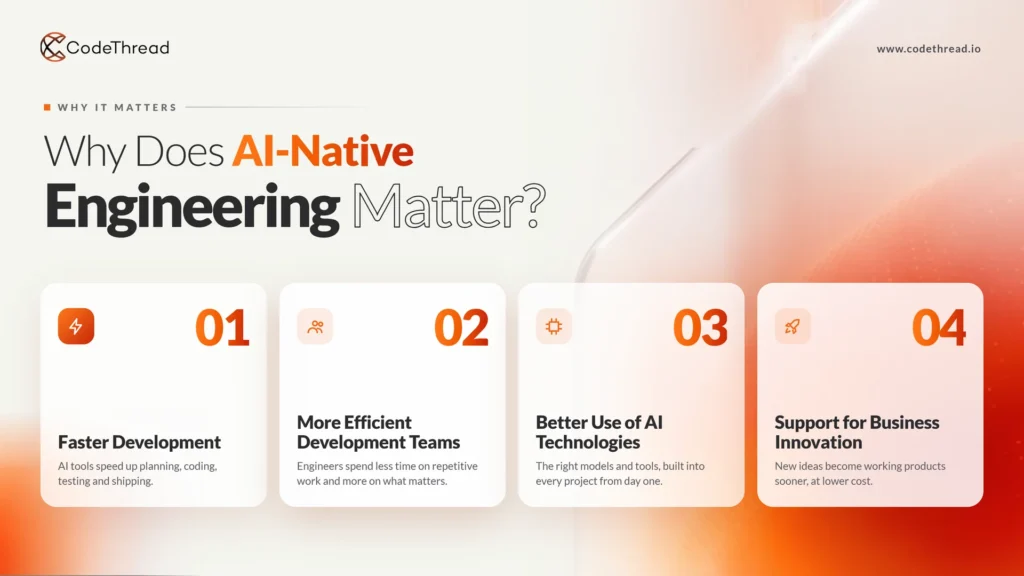
Engineers can use AI tools to speed up specific tasks, such as code generation, documentation, and initial testing.
This can provide development teams with additional time to concentrate on more challenging issues, though the increase in productivity varies with the project and the specific use of AI tools.
AI-native engineers can use AI to handle repetitive work and support existing development processes. This can help teams to work more efficiently without the need for all their manual work.
Companies that are investing in AI require engineers with expertise in both software development and the application of AI.
AI-native engineers can help connect these areas by developing AI-powered features, integrating language models, and identifying practical ways to use AI within existing products.
Companies can explore new product features and development approaches with engineers who understand how AI fits into modern software development.
This can be particularly useful for startups and growing businesses that want to introduce AI capabilities into their products without losing focus on quality and reliability.
Having an AI-native engineer on your team can be beneficial if your company is looking to integrate AI into the software development lifecycle or plan to create products that utilize AI technologies.
If you need this expertise, you might want to:
When you’re hiring, keep in mind what you need, your current tech team, and what AI skills you’re looking to build.
Businesses that need ongoing AI development support may also benefit from working with an embedded AI engineer. These engineers work alongside existing teams to build AI-powered applications, integrate LLMs, and develop AI agents based on specific business requirements.
Adopting AI in software development requires engineers who understand how to use AI tools while maintaining the technical standards your business expects.
Businesses looking to create AI-powered applications, integrate LLMs, build AI agents, and enhance their engineering capabilities can rely on CodeThread for AI engineering support.
Our engineers collaborate with existing teams and business needs to assist in the development of viable AI solutions. Whether you’re building a new product or introducing AI into an established application, having the right engineering expertise can make the development process easier to manage.
Want to add AI skills to their engineering team? Explore CodeThread’s embedded AI engineers and book a free discovery call to discuss your requirements.
 maira asif
Many businesses want to use AI, but finding the right people to build and manage it isn’t always…
 maira asif
AI is transforming the way businesses operate, engage with customers, process data, and create new products. There are…
 maira asif
Learn how to choose the right AI development company by evaluating experience, AI development services, technical expertise, pricing,…