
 maira asif
Benefits of AI for Small and Mid-Sized Businesses.
Artificial intelligence (AI) is transforming businesses of every size. AI in small businesses is increasingly used to automate…

We transform complex ideas into simple, powerful digital solutions that scale with your business, helping you innovate faster, operate smarter, and deliver meaningful experiences
Artificial intelligence continues to move beyond automation and chatbots at a rapid pace. It is shaping up to be a year when long-simmering trends reach maturity rather than simply generate hype. New AI technologies are changing how companies build and use software. Here’s a closer look at the AI developments most likely to shape how businesses and developers build with AI this year.
Here are the top 8 AI trends in 2026:
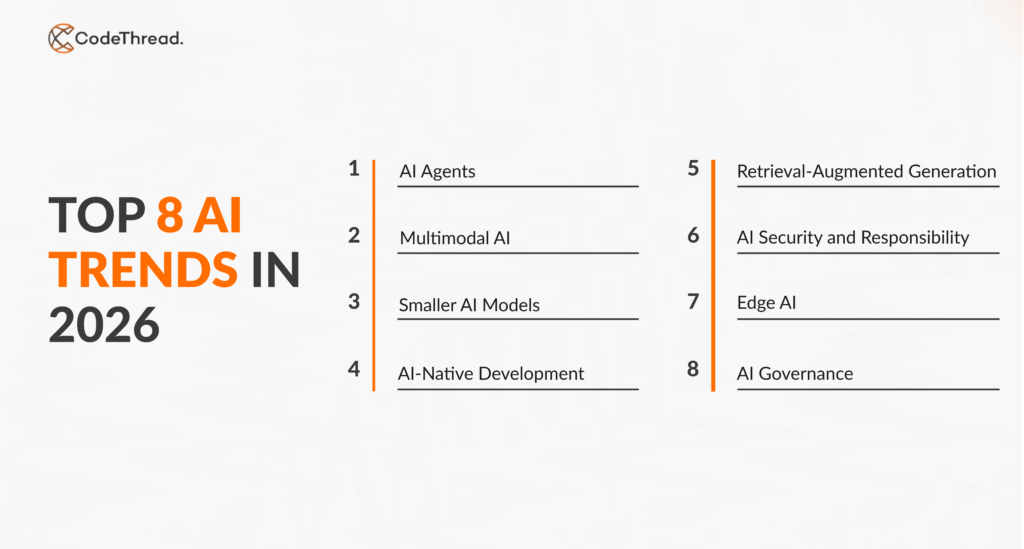
One of the biggest AI development trends in 2026 is the growth of AI agents. Most of the traditional chatbots focus on answering queries or giving information. AI agents are designed to take action. They can understand a goal, create multiple plans, use connected tools, find information, and execute tasks with minimal human interaction.
For example, an AI agent can qualify a sales lead, feed the data into a CRM, generate a report, schedule a meeting, or aggregate data from multiple business systems.
Google Cloud refers to 2026 as a time when agentic workflows are playing an increasingly important role in business processes, even in workflows with multiple agents. The transition from AI assistance to AI execution will likely shape the way businesses create their own software and automation.
AI systems are no longer limited to text; multimodal AI can handle various forms of data, such as text, images, audio, video, and documents. This allows developers to create applications that understand a broader picture of what is happening.
For example, a healthcare app might be able to handle written patient data and medical images. A construction solution may examine pictures of the site together with project-related documents. A customer service system could integrate voice dialogues, messages, and customer records.
According to Gartner, multimodal capabilities are among the technologies that facilitate the growing adoption of generative AI. As these capabilities become more readily available for integration, multimodal AI is becoming more common in business applications.
Larger models are not necessarily the right answer to every problem. In 2026, the trend has shifted towards small language models and AI models specialized for specific fields, which can perform specific tasks effectively. There are several advantages of smaller models when businesses require lower costs, quicker responses, higher control, and deployment nearer to the data source.
This could lead to a more flexible approach to AI development. Multiple models can be used in combination for individual applications, rather than a single model for all purposes.
Another key factor of growth is business automation. The previous systems were automated, but they were programmed according to predetermined rules. Today, AI automation can handle more unstructured data and adjust to various scenarios.
For example, an AI-based workflow can be used to scan incoming documents, identify key details, categorize the request, verify business data, and assign the task to the relevant department.
AI is now becoming a part of the software development process. Programmers in 2026 are creating faster and better applications with AI tools, such as for coding, testing, debugging, and documentation. AI-native development also involves creating software with AI features built in from the start, rather than incorporating them afterward.
This strategy can be used to help organizations develop more intelligent, flexible applications while minimizing repetitive development efforts.
Retrieval-Augmented Generation (RAG) is becoming more advanced as businesses look for AI systems that can work with their own data. RAG enables AI models to extract relevant information from company documents and databases, which helps them produce more accurate responses.
In 2026, the ability of AI to provide more contextually relevant and informative responses is being enhanced by better retrieval techniques. This renders RAG valuable for customer support, internal knowledge bases, enterprise AI solutions, and document analysis.
As agentic multimodal systems take on more responsibility. Developers should consider security issues to avoid unauthorized access, model misuse, and unreliable outputs. Businesses are giving greater attention to AI governance and security rather than treating them as an afterthought.
Responsible AI practices can help businesses build systems that are more secure, safer, more transparent, and better aligned. AI vendors’ practices are based on how seriously they take safety and how honestly they document what their model can’t do, especially in industries like healthcare and finance.
AI doesn’t have to be cloud-based all the time. Edge AI enables some AI processing to take place near the source of the data. This can be helpful when applications require a low response time, offline access, or the need to manage sensitive data. These can include cameras, industrial equipment, vehicles, mobile devices, and other connected systems.
This is a more viable approach with the smaller and more efficient models. IBM notes that improvements in model compression, quantization, and memory-efficient runtimes are supporting AI deployment on edge devices and clusters.
Edge AI may be a more valuable component of application development in industries where real-time decisions are key.
Governance is more important as AI systems become more autonomous. Companies must be aware of what their AI systems are doing, what information they can access, and when they need human approval. Responsible aspects of AI development, such as security, privacy, monitoring, access control, and auditability, are increasingly crucial. To developers, it means there is no time to add AI security at the end. It needs to be considered during system design.
The most significant shift in the progress of AI is that models are getting better. That’s because AI is becoming more integrated with actual business processes.
Now, businesses can access solutions that integrate AI models, automation, company data, software integrations, and human oversight within a single system.
Not all businesses require the latest AI technology, however. The right way will depend on the problem being solved, data available, technology requirements, budget, and business value that is expected.
An AI strategy could begin by automating one manual or time-consuming process and then be expanded and evaluated after implementation.
| AI Trend | Main Benefit | Business impact |
| AI Agents | Task automation | More efficient workflows |
| Multimodal AI | Understands multiple data | Better user experience |
| Smaller AI models | Lower resource requirements | Cost-effective AI |
| AI Coding Tools | Faster development | Higher developer productivity |
| Advanced RAG | Better access to business data | More useful AI assistants |
| Responsible AI | Safe AI systems | Greater trust and compliance |
| Edge AI | Faster local processing | Better real-time applications |
The AI trends for 2026 are promising a future of practicality and connectivity. The development of modern AI solutions is being influenced by several key trends such as AI agents, multimodal applications, smaller models, AI automation, domain-specific systems, edge AI, and robust governance.
The future of AI is more than just developing more intelligent models. It’s about connecting those models to real work and creating systems that will provide tangible value.
If you’re thinking about developing AI for your business, the important points to keep in mind are that it must be useful, the data must be solid, the technology must be right, and the implementation must be responsible.
Looking to discover the possibilities of AI for your business? Begin with a business challenge, understand the potential value of AI, and then proceed to develop.
If you’re looking to turn these AI trends into practical solutions for your business, explore our AI-powered solutions to see how we can help you find the right approach for your goals.
 maira asif
Artificial intelligence (AI) is transforming businesses of every size. AI in small businesses is increasingly used to automate…