 maira asif
AI Development Cost Guide: Budgeting for Your Project
AI is transforming the way businesses operate, engage with customers, process data, and create new products. There are…

We transform complex ideas into simple, powerful digital solutions that scale with your business, helping you innovate faster, operate smarter, and deliver meaningful experiences
AI is not just a technology in a research lab anymore; it has proven itself to be a useful tool for today’s businesses. However, for some executives, the idea of AI development remains tied to the background: technical, complicated, and hard to plan for.
AI development is a structured and repeatable process. It’s not a technical document, so you don’t need to be a technical expert to understand it. The most important thing is understanding what’s being constructed, how development goes, and what business decisions you’ll need to make as you go.
This guide explains everything business leaders need to know about AI development. You will learn what AI development is, the step-by-step process of creating AI, its business potential, common use cases, and what you should take into account before investing in an AI solution.
The development of AI involves creating, constructing, training, testing, and launching programs capable of executing activities that rely on human intelligence. They involve pattern recognition, understanding language, prediction, and automated decision-making from data.
The key difference between AI-powered software and traditional software lies in how they operate. Traditional software follows predefined rules written by developers, for example, “If this happens, do that.” AI systems, on the other hand, learn from data, rather than just following hard-coded instructions. They use a significant amount of historical data to recognize patterns, make predictions, and enhance their performance when new data arrives.
AI development may involve the integration of several technologies to address a specific business challenge, rather than relying on a single capability. The most popular technologies are:
1. Machine Learning (ML)
Allows systems to learn from past data and make predictions or recommendations.
2. Natural Language Processing (NLP)
Empowers software to comprehend, interpret, and create human language for use in applications such as chatbots, virtual assistants, and document analysis.
3. Computer Vision
Enables AI to process images or videos for object identification, defect detection, or facial or text recognition.
4. Generative AI
Generates new text, images, code, and audio from user requests or from existing data.
5. Predictive Analytics
Predicts trends, customers, demand, and potential business risk based on the historical and real-time data.
However, in reality, most business AI solutions integrate multiple of these technologies. For example, an AI customer support system can leverage natural language processing to interpret customer inquiries, machine learning to enhance accuracy over time, and generative AI to generate personalized responses. Combining various AI features allows businesses to create more precise, scalable, and goal-oriented solutions.
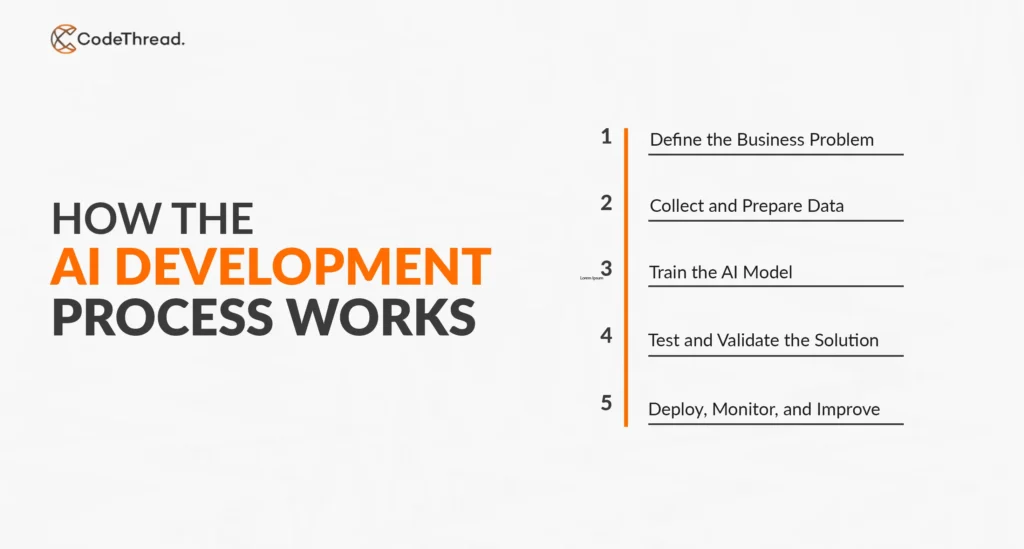
Although each AI project is different, most AI projects follow a similar process to ensure the solution addresses a real business problem and achieves measurable results.
The first step in a successful AI project is not the desire to use AI, but rather having a specific goal. The initial step is recognizing a particular business challenge, like automating repetitive tasks, boosting customer support, or predicting needs. A well-defined problem helps set clear goals and measure the project’s success.
Data quality is crucial because AI models rely on data to learn. Information is gathered from business systems and structured to produce accurate and reliable results. The more reliable and useful the AI solution, the higher the data quality.
AI models are chosen based on their availability and trained with historical data. In this phase, the model will be trained to recognize patterns and then make predictions or decisions automatically. The model is continuously improved and refined to achieve greater accuracy and efficiency.
The AI solution is validated for accuracy, reliability, and performance before deployment. This helps ensure it delivers consistent results in real-world scenarios. If any problems are detected during testing, they are addressed prior to the solution going live.
The AI solution is integrated once validated into existing workflows. Regular checks and updates ensure data is accurate over time, reflecting changing business requirements and data. Continuous enhancements maintain the long-term value of the AI system to the business.
AI development enables businesses to address practical, real-world issues and generate tangible results. Some of the most common benefits include:
Automate repetitive tasks like data entry, document processing, and scheduling to improve productivity.
Analyze large datasets to generate accurate forecasts and actionable insights.
Provide customized recommendations, AI assistance, and quick responses.
Reduce human error, identify anomalies, and improve business processes.
The effectiveness of AI will vary depending on the business problem being solved, and it’s important to establish clear goals before development.
Before investing in AI development, ask these key questions:
Answering these questions minimizes project risks, optimizes project implementation, and maximizes the value of your AI investment.
The development journey of AI doesn’t need to start with a massive transformation. Whether it’s automating a repetitive task, streamlining operations, or boosting customer satisfaction, many successful enterprises begin with a clear objective that defines the use case for their growth. This approach minimizes risk, delivers measurable results faster, and creates a strong foundation for future AI initiatives.
The first step is to understand the development of AI. The next step is to determine where AI can offer the most value to your business and then find the right AI development company to help you with everything from understanding your objectives to recommending the best solution and helping you through the development process.
Talk to our AI development experts today and learn about your project while exploring how CodeThread can assist you in creating scalable and future-proof AI solutions.
1. What is AI development in simple terms?
AI development refers to creating AI software that learns from data to automate tasks, make predictions, and solve business problems.
2. Is AI development the same as software development?
No. AI development is a type of software development that uses data and machine learning to build intelligent applications.
3. Why do AI systems need ongoing monitoring?
Monitoring and updating AI models should be done regularly to ensure accuracy, given the evolving nature of data and business.
4. What kind of data does an AI system need?
AI systems are trained with high-quality business data, like customer records, transactions, and operational data.
5. How long does AI development take?
The timelines will vary based on the project’s complexity, but most AI solutions will take a few weeks to a few months.
6. Can small businesses benefit from AI development?
Yes. AI is an effective tool for businesses of all sizes to automate tasks, enhance efficiency, and make better decisions.
 maira asif
AI is transforming the way businesses operate, engage with customers, process data, and create new products. There are…
 maira asif
Learn how to choose the right AI development company by evaluating experience, AI development services, technical expertise, pricing,…
 maira asif
Explore the differences between generative AI and traditional AI, including use cases, benefits, limitations, and how businesses can…