 maira asif
What Is AI Development? A Complete Guide for Business Leaders
AI is not just a technology in a research lab anymore; it has proven itself to be a…

We transform complex ideas into simple, powerful digital solutions that scale with your business, helping you innovate faster, operate smarter, and deliver meaningful experiences to your users.
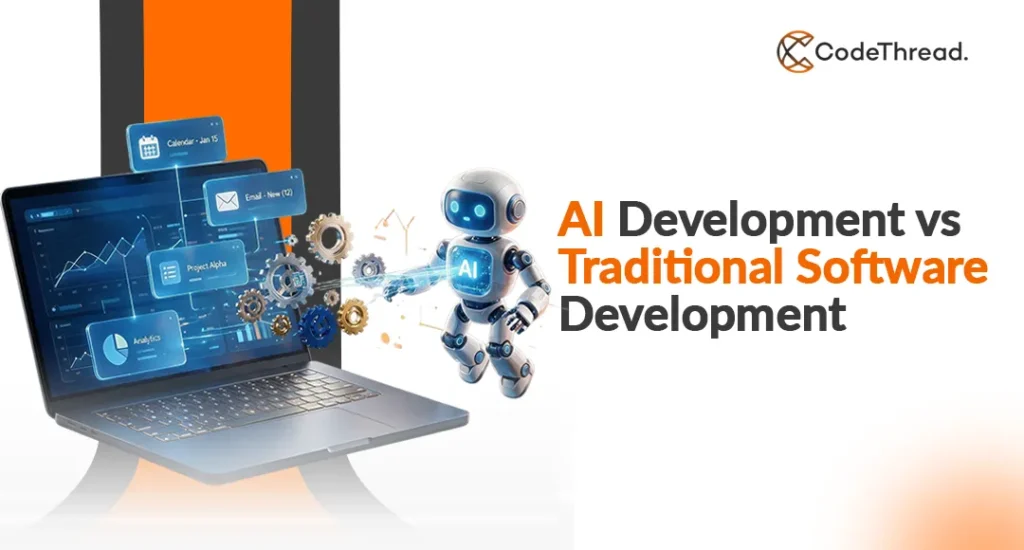
As we all know, technology is evolving faster than ever, which constantly increases pressure on businesses to build more reliable, smarter software. For many years, traditional development has become a standard approach for creating websites, enterprise systems, and mobile applications. Traditional software development relies on predefined rules and consistent results, whether written by developers or based on programmed instructions.
On the other hand, artificial intelligence is transforming software design, development, testing, and maintenance. AI development helps systems analyze data, make predictions, recognize patterns, and improve their performance. AI is not just about adding intelligence features to a system.
The choice between AI development and traditional software development depends on the project, business goals, budget, and long-term requirements.
Artificial intelligence (AI) development is the process of creating software that can learn from data, identify patterns, recognize trends, and make unbiased decisions. AI systems improve their performance by analyzing and adapting their features over time. It does not depend on fixed programming rules.
AI helps in bringing technologies together such as machine learning, deep learning, and natural language processing (NLP). All of these systems and technologies are capable of handling tasks that require human intelligence, such as recognizing speech, image understanding, predicting customer behaviour, and language translation.
AI applications learn and improve their performance as they collect new data. This ability of AI makes it more valuable in industries that need automation, accuracy, and real-time decision-making.
AI-powered applications have several stages that help the system to learn and perform effectively.
This process begins by gathering relevant data from different resources. The foundation of a successful AI model is high-quality data because it helps to determine how correctly the system can learn, work, and make predictions.
In this process, the collected data is cleaned, organized, and formatted by removing duplicate Data, and correcting errors. All these steps help AI to increase model reliability.
The model gradually learns how to make accurate predictions during training, and machine learning algorithms help to analyze the prepared data.
Before deployment, AI models are tested using new data to measure model accuracy, reliability, and performance. Developers improve the model if any improvement is needed and test the model to identify any bugs or errors.
After successful training, the AI model is turned into websites, enterprise systems, or mobile applications where users can interact with it.
Unlike traditional software, AI systems require ongoing monitoring. New data helps to retrain the model, which allows it to improve accuracy and adapt to new changes with the passage of time.
AI has become part of everyday life. Some common examples include:
These applications demonstrate how AI improves efficiency, accuracy, and user experience.
Traditional software development is the process of designing and building applications using predefined rules and predefined programming logic. Developers give instructions to the model about how exactly the model responds to different inputs. The model constantly follows these rules. The code is only manually updated.
This system is the foundation of software engineering. It is widely used for business systems, government platforms, financial applications, and websites that require predictable behaviour.
A traditional approach is ideal for projects where rules are pre-defined, and decision-making does not require learning from data.
Traditional software development follows a structured process known as the software development lifecycle (SDLC). In SDLC, each step leads to the final product that meets user requirements, improves reliability, and maintains high quality.
It is important to understand the client’s objectives for a successful project. Developers focus on user needs, gather requirements, define project scope, and document all functional and technical specifications. Requirement analysis helps to reduce future errors and costly changes.
After requirement analysis, it’s time to create a roadmap that includes estimating cost and time, allocating resources, identifying potential risks, and choosing the best technologies and strategies.
At this stage, software architects design the application structure. In this process, developers define the database, user interests, system architecture, and all the security frameworks before coding begins.
Developers write the source code using programming languages like Java, Python, C++, or JavaScript. Developers build every feature according to the user requirements and approved design.
The software is tested before release to identify any bugs, performance issues, and security vulnerabilities in the application. This step of testing ensures that the application functions correctly under different conditions.
After successful testing, the software is released to users. Deployment may happen all at once or in multiple phases, like phased, parallel, and big bang deployment, depending on the project.
Software development does not end after launch. Developers continuously improve application performance, fix bugs, add new features, and also ensure compatibility according to user needs and advanced technologies.
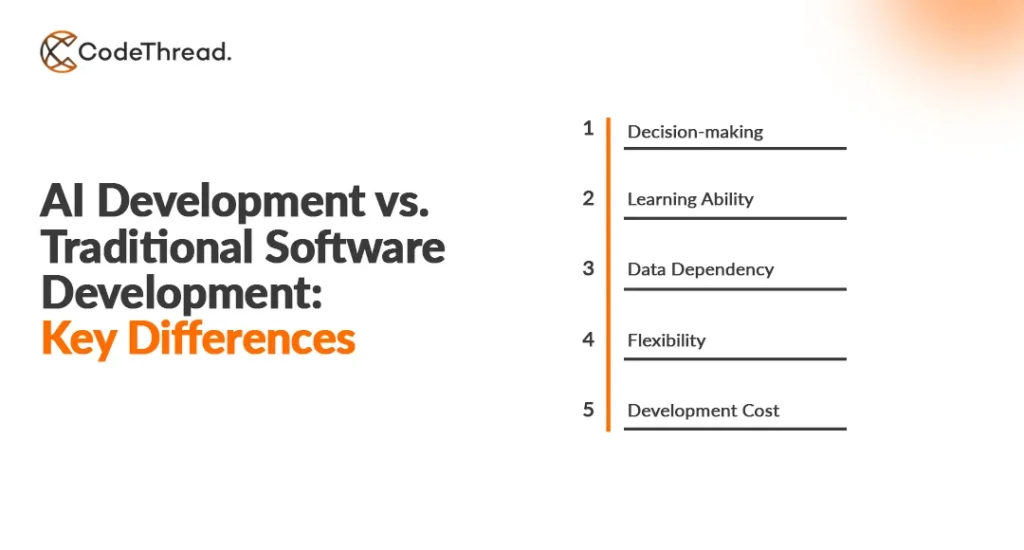
Although both approaches aim to build software applications, they differ in how they are designed, developed, and maintained.
Traditional software follows a predictable development path, while AI is an ongoing learning process that improves and learns from new data with the passage of time. Their workflows are quite different.
Testing plays an essential role in both approaches, but the focus or method of testing is different. In traditional testing verifies that every feature works according to the refined requirements.
Common traditional testing methods include
AI testing ensures the intelligence and reliability of the model rather than only checking software functionality.
Important AI testing methods include
There are many advantages of AI development, which are given below:
Artificial intelligence systems are capable of analyzing huge volumes of data in seconds, which helps in making fast and reliable decisions.
It helps to reduce manual effort and also operational cost by automating repetitive tasks such as customer support, document processing, and data analysis.
AI always adopts a user-centric approach, keeping users at the center by analyzing user behaviour to offer personalized recommendations, customized services, and improved customer satisfaction.
AI allows employees to focus on problem-solving and high-value work, which in turn increases overall productivity.
Traditional software produces secure and predictable applications, so it remains a trusted option for many organizations.
As we know, it follows predefined rules, and it helps to ensure consistent results on the same action. This feature makes it well-suited for banking and government use.
The logic of the application is well-defined. New features can also be added with planned updates. Issues are easy to find and fix quickly.
Unlike AI projects, traditional software does not require expensive model training, making it a cost-effective approach for many businesses.
There are set rules in traditional software, so it provides dependable performance without requiring continuous learning or retraining. Every function is programmed by developers, which gives organizations complete control over the software behaviour.
AI has many powerful capabilities but also comes with several challenges.
AI solutions require advanced tools, skilled professionals, and high-quality datasets, which increase overall project cost.
The success of an AI model depends on the quality and quantity of data. Incomplete or biased data reduces accuracy and leads to poor decision-making.
AI projects involve data preparation, model training, validation, and continuous improvements, making them more complex than traditional projects
AI models need regular evaluation and retraining because user behavior and conditions change over time.
Traditional software also has many limitations given below
These systems are well in structured environments, but they struggle with tasks that require prediction, pattern recognition, or intelligent decision-making.
Adding new features or modifying business often requires additional development, testing, and deployment.
In traditional software, many tasks still depend upon human effort, which causes a reduction in efficiency and also increases operational costs.
The cost of development depends on project size, technology, and user or business requirements.
AI development requires a higher initial investment because of the data collection, model training, and ongoing monitoring.
Traditional software development is usually less expensive than AI development in the initial stage, which makes it the best choice for projects with defined requirements. However, long-term maintenance costs can increase with the passage of time as new features are added.
AI is widely used in industries that depend upon data analysis and automation.
EXAMPLES INCLUDE:
Traditional software is preferred for applications that require consistent and rule-based operations.
EXAMPLE INCLUDE:
Many businesses do not choose one approach over the other. Instead, they combine AI capabilities with traditional software to build more smarter applications.
For example, an online shopping platform may use AI to recommend products based on customer preferences and use traditional software to manage orders and payments.
The hybrid approach allows businesses to maintain more reliability, benefiting from both approaches.
I think the future of software development lies in closer collaboration with human developers and artificial intelligence (AI) technologies.
AI is not replacing traditional software development; it is enhancing it. Development processes are being made faster, smarter and more efficient through predictive analytics, analytics, intelligence testing, and automated deployment.
Artificial intelligence will largely determine the future of software development because in the coming years, developers who learn to work with AI will have a significant advantage as software products become more intelligent, user-centered, and scalable.
Artificial intelligence and traditional software development play a vital role in today’s technology. Traditional development continues to provide reliable, secure, and predictable solutions for applications. On the other hand, AI enables us to build intelligent systems that learn from data, automate, and deliver personalized experiences.
In my opinion, instead of viewing these two approaches as competition, many organizations use hybrid approaches and integrate AI capabilities into traditional software, which helps to create a balanced solution that combines stability with innovation.
As technology continues to evolve, businesses that understand the strength of both approaches will be better able to build scalable, efficient, and future-ready software solutions.
 maira asif
AI is not just a technology in a research lab anymore; it has proven itself to be a…
 maira asif
AI is not a business idea for the future; it is a business need of today. In 2026,…
 maira asif
Modern application development is changing due to artificial intelligence. AI is becoming a vital part of digital innovation,…