 maira asif
How to Choose the Right AI Development Company
Learn how to choose the right AI development company by evaluating experience, AI development services, technical expertise, pricing,…

We transform complex ideas into simple, powerful digital solutions that scale with your business, helping you innovate faster, operate smarter, and deliver meaningful experiences
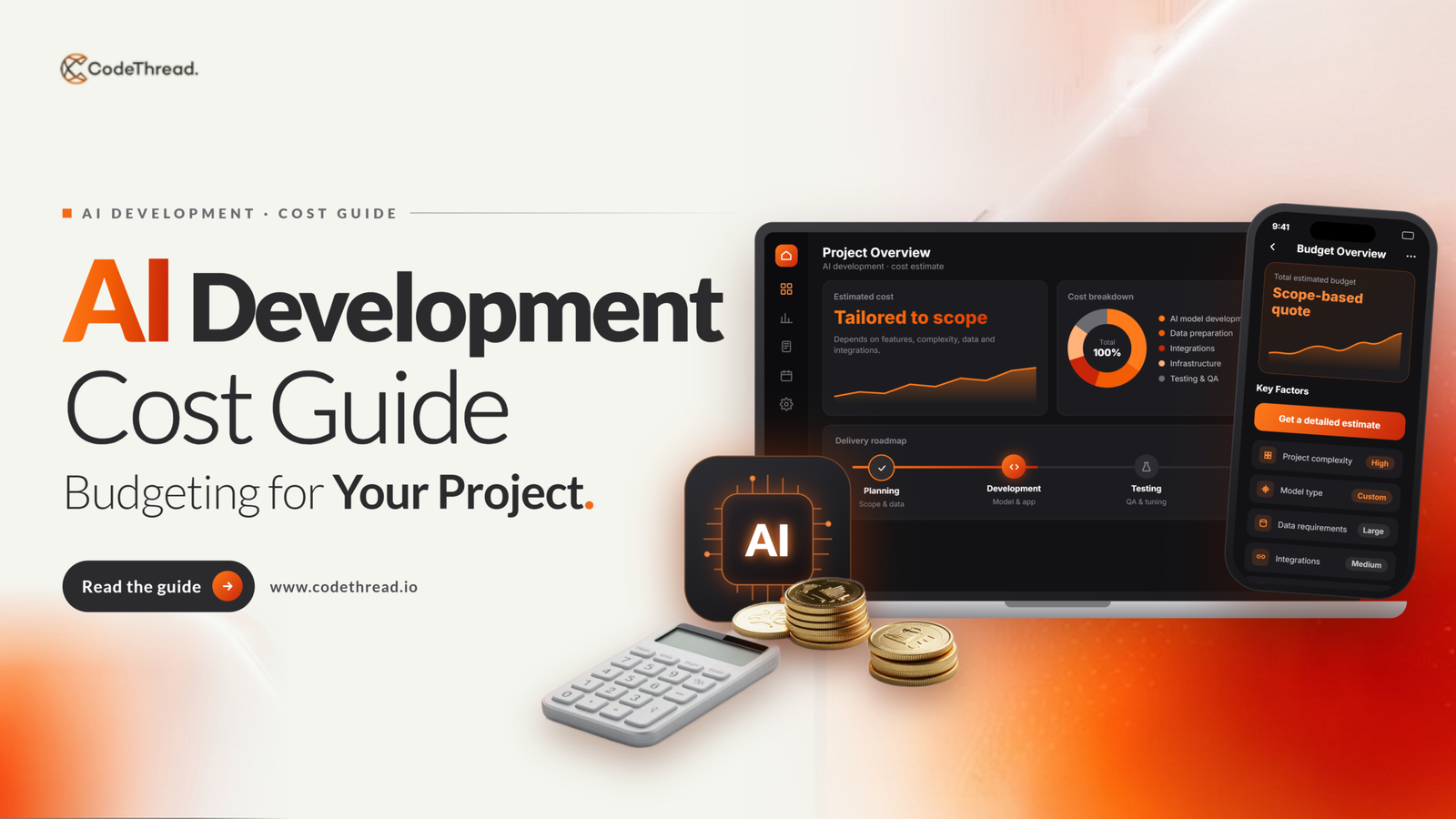
AI is transforming the way businesses operate, engage with customers, process data, and create new products. There are multiple possibilities for businesses to integrate AI into their workflows, from AI chatbots to automated workflows and AI-powered predictive analytics. But before deciding on the solution, there is one important question that needs to be answered: What is the price of the solution?
AI development costs vary depending on the type of development required, level of customization, data quality, and integration with in-house systems.
The cost of a simple AI feature will differ significantly from that of a custom app that integrates with a number of systems, provides advanced security, and has specialized machine learning capabilities.
Before knowing these costs, you can make informed decisions about your development, prioritize features, and budget for post-launch expenses. We will discuss all the factors that affect AI development costs, break down the costs of various types of AI projects, and provide practical tips for managing your investment.
The following table provides illustrative estimates for common AI projects.
| AI Project Type | Estimated Development Cost |
| AI proof of concept (PoC) | $5,000–$25,000 |
| Basic AI chatbot | $5,000–$20,000 |
| AI workflow automation | $15,000–$75,000 |
| AI-powered business application | $20,000–$80,000 |
| Custom AI assistant with company data | $25,000–$100,000 |
| Custom machine learning solution | $50,000–$200,000+ |
| Enterprise AI platform | $150,000–$500,000+ |
These are indicative planning ranges, not guaranteed market averages. Costs depend on the provider, the scope of the project, the amount of data needed, data integrations, and production needs.
A proof of concept is used to see if an AI can actually answer a particular question. A minimum viable product (MVP) extends that idea one step further by releasing a reduced version of the product to test with users. The solution needs to be further developed to support real users and include security, reliability, monitoring, and system integrations.
Moreover, development costs should be differentiated from the recurring operating costs. After the launch, additional costs may arise through API usage, hosting, maintenance, and third-party subscriptions.
The level of development required varies from one application of AI to another. Knowing these differences will help you to determine which will be the best solution for your needs and budget.
AI-powered chatbots can be used to resolve customer queries, give information about products, qualify leads, and assist staff members. They can vary depending on the complexity of conversations, knowledge sources, integrations, and communication channels.
A simple chatbot with a fixed set of questions and responses with a pre-trained AI system is likely to cost less. Further development and testing are required for a more advanced assistant, which can access company documents, update a CRM, schedule appointments, and work with multiple channels.
AI workflow automation is the integration of AI capabilities into business processes that minimize repetitive manual tasks. Common applications include email classification, document processing, customer inquiry routing, and automated data entry.
One workflow with a couple of applications is usually cheaper than one that can coordinate tasks across multiple departments.Complex workflows may also require approvals, error handling, and human review to ensure important actions are completed properly.
Custom AI software is designed for specific business requirements. It can be used in intelligent search applications, recommendation systems, demand forecasting tools, and AI-driven business platforms, among others. The price varies depending on the features, the user interface, the backend, the data preparation, and the model selection. The cost of the application may rise significantly. If it needs to be built with special machine learning capabilities or a large number of integrations.
AI agents can process information, connect with tools, and take multiple actions towards a specific objective. For example, a sales agent might qualify an inquiry, check product availability, update customer records, and schedule a meeting.
Development costs depend on the complexity of the agent’s tasks, the number of connected systems, and the level of autonomy. Extra protection can be required when an agent is able to add, modify, or create business activities or communicate with customers.
Enterprise AI solutions are frequently used by various teams and can help address specific operational needs. These can include advanced permissions, extensive data processing, complex integrations, comprehensive monitoring, and compliance measures.
Enterprise projects can be far more costly than smaller AI projects because of these requirements. Phased implementation enables businesses to deploy priority features initially and roll out the solution at their own pace based on requirements.
The price of an AI project depends on more than the model or technology selected. The overall budget is determined by a number of technical and business decisions.
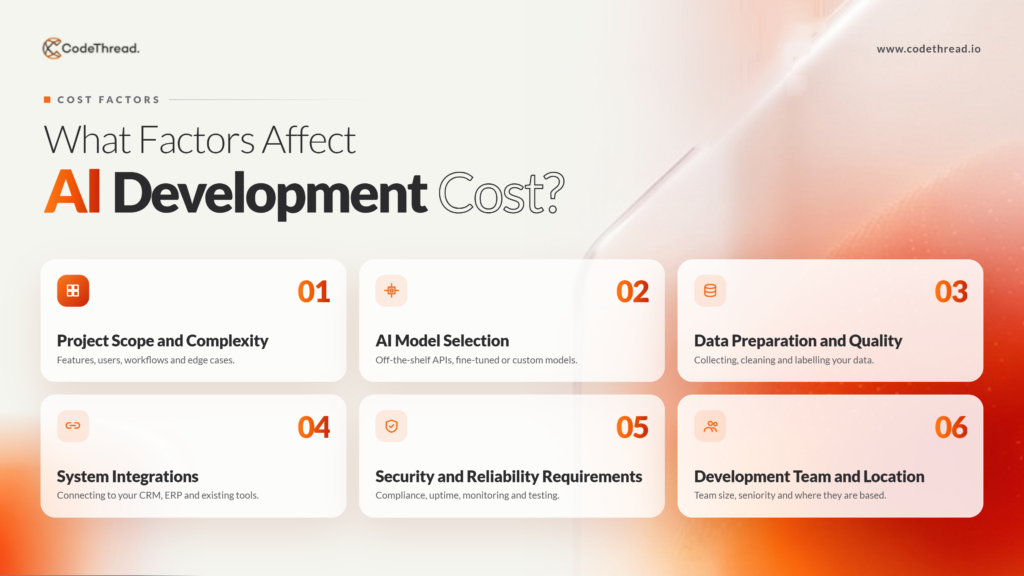
A well-defined project with a few features is easier to estimate than a project with varying requirements and several workflows.
For example, an AI assistant answering questions in given documents is more restricted than an agent answering customers, updating a CRM, checking inventory, and making appointments. Define the main problem, essential features, expected users, and desired results before development begins. This helps to avoid unnecessary features adding up to the budget.
Businesses can use existing AI models, customize existing models, or develop specialized machine learning systems. If a solution is already available via an API, then the time and resources needed to launch a solution can be cut down. Fine-tuning may be needed if the model is intended for a specific task where it needs to be tailored to that purpose.
Retraining a model from scratch typically involves a significant amount of information, computing power, and skill. This will vary by your required accuracy, business requirements, data privacy requirements, and usage expectations. Not all applications necessarily call for a more costly model.
AI systems require suitable data to yield valuable outcomes. If your business already has accurate and organized information, it can be easier to develop. But incomplete records, formats that vary, duplicated data, and data not available can create other challenges.
However, the datasets have to be cleaned, documents organized, examples labeled, and data pipelines set up before the system can effectively use the information. By evaluating data readiness early, you can uncover these costs before development begins.
AI-powered solutions frequently must integrate with other software such as CRMs, databases, websites, calendars, inventory systems, and customer service platforms. API configuration, authentication, data mapping, testing, and error handling may be necessary for each integration.
The development of additional tools or integrations may be needed for older systems or platforms. Make a list of all the systems that your AI solution needs to interact with and determine which integrations are essential for the initial release.
If your business has sensitive information, you need to have the right protection measures in place. These can range from access controls, encryption, audit logs, and data retention policies all the way to human approval for critical actions, depending on the use case.
Testing is also part of the budget. Developers should consider output, accuracy, response times, failure modes, and performance under anticipated loads. Planning for these requirements from the beginning is more effective than treating security and reliability as optional additions.
Development cost will also vary based on the team you choose, their experience, and the engagement type. An experienced team may identify technical risks earlier and help you avoid unnecessary development work.
But the overall expense is still determined by the scope, timeframe, and number of specialists who are involved in the project. Evaluate proposals based on the scope of work, experience, communication, testing standards, and post-launch support, not just hourly rates.
Businesses can hire freelancers, build an in-house team, work with an AI development company, or hire an embedded AI engineer. Freelancers are suited to smaller tasks, while in-house teams offer long-term control but come with salaries and recruitment costs. Development companies provide access to a range of skills, while embedded engineers work directly with your team.
The right option depends on your project scope, budget, and long-term development needs.
The starting development quote may not include the actual expense of running an AI application. Recurring costs should be included in a business plan.
There are several regular expenses to consider, such as
Model usage can become a significant ongoing cost for an AI application, especially when handling large volumes of requests. To estimate these costs, forecast your expected usage and compare pricing from suitable providers.
When evaluating total cost of ownership, consider initial construction, deployment, ongoing expenses, and expected upgrades over the lifetime of your operation.
Artificial intelligence does not require a high-end custom platform to be useful for small businesses and start-ups.
A project can be used to test an idea or solve a specific operational problem before the business invests in a larger project.
For example:
When choosing custom development, consider comparing off-the-shelf software, API solutions, and custom applications. Subscription tools can work for a common need, whereas custom solutions can be warranted if the existing tools do not support your workflows or integration requirements. Working on one specific use case assists you in evaluating the outcomes before extending the project.
A clear budget helps you prioritize features, estimate expenses, and avoid unexpected costs. Follow these five steps to plan your AI project.
Identify the problem you want to solve, such as automating tasks, improving customer support, or qualifying leads. Set measurable goals to track success.
Focus on must-have features first. You can add advanced functionality, such as CRM integrations or multilingual support, as your needs grow.
Account for development, integrations, testing, deployment, API usage, hosting, and ongoing maintenance.
Use a proof of concept (PoC) to test feasibility or a minimum viable product (MVP) to validate your solution with real users before expanding.
Set aside a contingency budget for data issues, technical challenges, and scope changes. Agree on how additional costs will be handled before development begins.
Planning an AI project requires more than estimating the initial development cost. You need to understand the business problem, define the required features, evaluate your data and integrations, and account for the expenses involved in running the solution.
A focused approach can help you test your idea, prioritize investment, and expand when the results justify further development.
CodeThread helps businesses explore AI solutions, workflow automation, and custom software development based on their operational needs. Whether you need an AI assistant, an automated workflow, or a larger AI application, start by defining what you want the solution to accomplish.
Ready to explore AI for your business?
Discuss your project requirements with CodeThread and identify a practical starting point for your AI development budget.
 maira asif
Learn how to choose the right AI development company by evaluating experience, AI development services, technical expertise, pricing,…
 maira asif
Explore the differences between generative AI and traditional AI, including use cases, benefits, limitations, and how businesses can…
 maira asif
INTRODUCTION As we all know, technology is evolving faster than ever, which constantly increases pressure on businesses to…