 maira asif
AI Development Cost Guide: Budgeting for Your Project
AI is transforming the way businesses operate, engage with customers, process data, and create new products. There are…
We transform complex ideas into simple, powerful digital solutions that scale with your business, helping you innovate faster, operate smarter, and deliver meaningful experiences
Choosing the right AI development company can have a major impact on the success of an AI project. The right partner can help you identify practical use cases, build a solution that fits your business, and integrate AI into your business systems. The wrong choice could result in a lack of requirements clarity, unnecessary expenses, technical issues, and an AI product that fails to provide any meaningful insights.
There are a number of companies providing AI development services, making it hard to distinguish which one is ideal for your enterprise. A strong portfolio is a good thing, but it’s not everything. It’s also important to assess the company’s technical capabilities and how long its development process typically takes, how they communicate, their experience with integrations, and their ability to support the solution following the launch.
It’s helpful to understand what it takes to build AI first before you start comparing companies. Our guide on What Is AI Development? A Guide for Business Leaders explains the fundamentals of AI development and how businesses can use AI to solve practical problems.
Here are the main points to keep in mind when selecting an AI development company and the questions to ask before beginning a project. An AI development company helps businesses design, develop, integrate, and maintain AI-powered software and systems.
Depending on your goals, an AI development company may work on solutions such as:
Some companies specialize in a specific type of AI, and other companies offer more comprehensive AI development services. The solution will be based on the problem you are solving. There is no need for the most advanced artificial intelligence model or a complicated custom system. In many cases, an existing AI model combined with the right data, integrations, and workflow automation can provide a better business outcome.
The technology behind AI projects is evolving rapidly, and the appropriate implementation varies according to the use case, which makes them unique compared to traditional software projects.
However, if customers are mainly interested in product information, their order status, or appointment booking, the chatbot should be built around these features. Your AI partner should be able to help you transform your idea into a solution.
They should be able to answer questions such as:
A good development partner does not just build what you ask for. They assist you in identifying what actually needs to be constructed.
Here are ten key factors to consider when choosing an AI development partner:
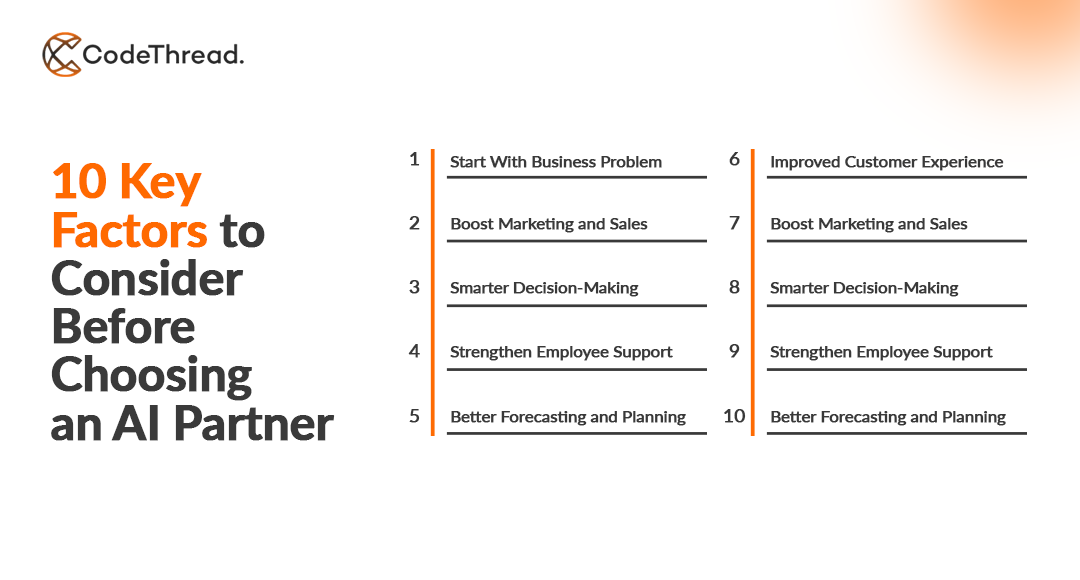
Before comparing AI development companies, clearly define what you want to achieve. Instead of starting with a technology such as “We need generative AI,” start with the business problem.
For example:
After the problem is understood, it becomes possible to decide if AI is the appropriate solution. A good AI development company should be willing to question the initial idea if another approach would work better. Sometimes, AI is the best answer. In other cases, traditional software, workflow automation, or a combination of the two might be the better choice.
Experience is important but not the number of years the company has been around. Look for experience related to the type of solution you need.
For example, if you are interested in an AI voice agent, find a company with experience in conversational AI, speech technology, APIs, and business system integrations.
When searching for an AI document processing system, check for experience with document extraction, OCR, structured data, knowledge retrieval, and workflow automation.
Ask potential partners:
Having relevant experience helps to mitigate risks during development, as there is a greater understanding of the technical and operational challenges involved.
Building an AI app is not just about integrating an app with an AI model.
Depending on the project, your development partner may need experience with:
Everyone doesn’t have to be an AI engineer to assess these features. Ask the company to explain how they would approach your project in simple business terms.
A good AI development company will be able to explain how the technology can be used and why it is appropriate, instead of just telling the names of popular AI tools.
A company’s portfolio can convey a lot more information than what the website states.
Identify case studies that describe:
Beware of portfolios that look good but give no details of the technology. A great example of a strong AI case study is how an AI agent can interact with a company’s product database, qualify leads, update a CRM, call in appointments, or search internal documents for information. Having a clear idea of how a company has done in the past makes it easier to know what it might be able to offer you for your business.
A reliable AI development company should have a clear process for moving from an idea to a working solution.
While every company has its own approach, AI development process may include:
Ask potential partners how they handle changes in scope, testing, feedback, and post-launch improvements. A clear process can make the project easier to manage and reduce surprises later
AI rarely works in isolation. Your AI solution may need to connect with your CRM, website, help desk, calendar, inventory system, ERP, communication platform, or internal database.
For example, an AI sales agent may need to:
It requires reliable integrations and a well-designed workflow. When evaluating an AI development company, ask which systems they have experience integrating and how they approach API limitations, authentication, data security, and system reliability.
The initial use case for your first AI project might be small, but successful AI systems grow over time. A chatbot could be integrated with a CRM. The document processing system could also process more documents in the future. An internal AI search tool could one day be expanded to a more comprehensive knowledge assistant.
It is important that your development partner thinks about how the solution can expand without a complete rebuild.
Ask:
Scalability is not about building a thing from scratch. It means making sensible technical decisions that leave room for future growth.
AI systems may be handling sensitive data, like business information, customer documents, or internal knowledge. Therefore, data security needs to be a part of the discussion from the start.
Ask an AI development company:
The specific requirements will depend on your industry and the type of information involved.
Technical skills are important. It is important to know who will lead your project and how communication will be handled.
Ask this question:
If you need to integrate your project with your internal team, check out a firm that can fit into your operations. The development partner should be able to convey the technical decision without having to make everything complicated.
The cost of AI development depends on the complexity of the project, integrations, data requirements, development time, and the support expected after the development. Do not compare the end price; compare what is included in each proposal.
See if it includes:
Discuss any recurring expenses, including AI model usage, cloud storage expenses, third-party API fees, and software licensing. A clear proposal should give you a better idea of what you are paying for and what is out of the scope of the original project.
Before choosing a development partner, consider asking these questions:
The answers can help you compare companies based on more than price.
Choosing an AI development partner is not just about comparing prices or finding a company that lists the latest AI technologies. The right partner should understand your business, identify where AI can create real value, and know how to turn an idea into a practical solution.
Start with your business problem. Then evaluate potential partners based on their relevant experience, technical capabilities, development process, integration expertise, security practices, communication, pricing, and long-term support.
It is also worth considering whether the company understands how AI fits into your broader business operations. The strongest AI solutions are not simply impressive demonstrations. They are built around real workflows and measurable business needs.
If you are comparing different AI approaches, our guide on Generative AI vs Traditional AI: What Businesses Need to Know can help you understand which approach may be more suitable for different business use cases.
It is also useful to consider where AI technology is heading before committing to a long-term project. Our guide to Top AI Development Trends to Watch in 2026 covers key developments trends businesses should be aware of when planning their AI strategy.
Choosing the right AI development company is an important decision because the development partner you select can influence your project’s cost, timeline, technical quality, and long-term success.
Look beyond marketing claims and focus on practical evidence. Review relevant case studies, ask how the company approaches your specific problem, evaluate its technical and integration capabilities, and make sure you understand the development process and ongoing costs.
Most importantly, choose a partner that sees AI as a way to solve business problems rather than simply a technology to add to your software.
The AI development company should help you identify realistic opportunities, build the right solution, integrate it into your existing workflows, and improve it as your needs change.
Ready to explore where AI could fit into your business? Start with a conversation about your goals, workflows, and the opportunities worth exploring.
 maira asif
AI is transforming the way businesses operate, engage with customers, process data, and create new products. There are…
 maira asif
Explore the differences between generative AI and traditional AI, including use cases, benefits, limitations, and how businesses can…
 maira asif
INTRODUCTION As we all know, technology is evolving faster than ever, which constantly increases pressure on businesses to…