 maira asif
AI Development Cost Guide: Budgeting for Your Project
AI is transforming the way businesses operate, engage with customers, process data, and create new products. There are…

We transform complex ideas into simple, powerful digital solutions that scale with your business, helping you innovate faster, operate smarter, and deliver meaningful experiences
Many businesses want to use AI, but finding the right people to build and manage it isn’t always easy. Hiring a full-time AI team can be expensive, and existing developers may not have the experience needed to work on complex AI projects.
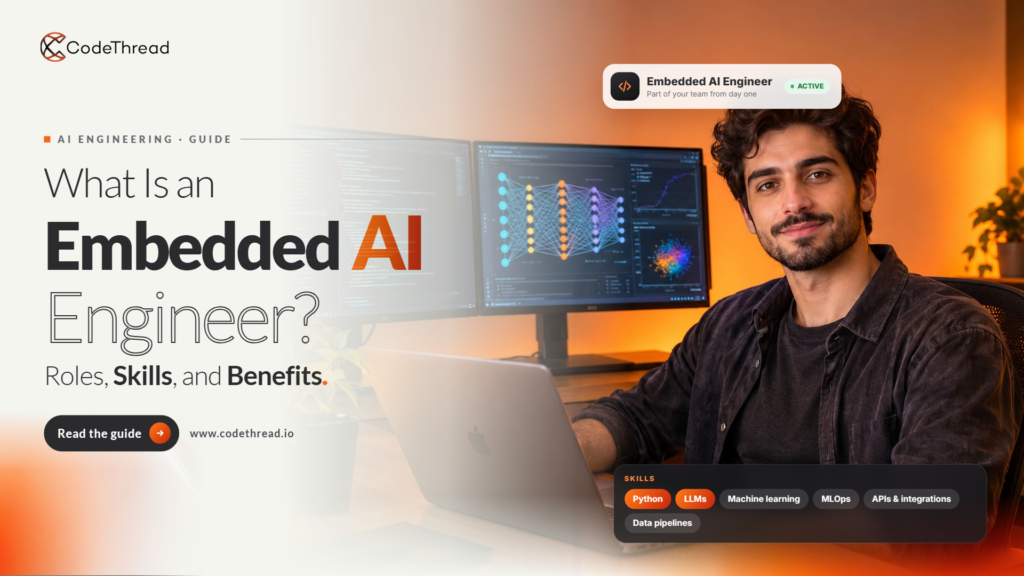
This is where an embedded AI engineer can be of service. They collaborate with your current team, understand your business needs, and participate in your business’s AI initiatives.
Whether building an AI-powered product, enhancing an existing application, or automating internal processes, an embedded engineer can assist your team with the technical support you require.
An embedded AI engineer is an AI specialist who works directly with a company’s existing team. Rather than coming in for a single job and then leaving, they can participate in ongoing projects and get to know the company’s products, systems, and development processes.
For example, a software company may wish to introduce an AI companion to a current application. An embedded AI engineer can assist in identifying suitable technology, linking the AI model to the application, testing responses, and collaborating with the development team to ready the AI model for deployment.
This is an ideal solution for companies that want to leverage AI without hiring a full-time employee for every new project. In this context, embedded refers to the engineer becoming part of the client’s working team, rather than developing AI specifically for physical devices or hardware.
The work depends on what a business wants to build. Some engineers focus on AI-powered software, while others work on automation, language models, or existing product improvements.
Here are some of their common responsibilities.
An embedded AI engineer can work to develop applications that leverage AI to address particular challenges. These can be customer support assistants, intelligent search tools, document analysis systems, or even personalized recommendations.
They collaborate with the current team to gain insight into the application’s requirements and how AI can fulfill them.
Businesses don’t always need a completely new application. Sometimes, they just want to see the AI capabilities integrated into apps they already use.
An embedded engineer can integrate APIs and other connections with current apps, databases, and business tools to embed AI models. For example, an AI assistant can be integrated into a knowledge system to help companies locate answers in internal documents without having to sift through several files manually.
AI agents can help businesses handle tasks such as answering customer questions, retrieving information, and working with connected software.
These agents can be created by an embedded AI engineer and integrated into the tools a business is already using. They can also create automated processes for email classification, document processing, and internal support. These workflows need to be tested by the engineer, who should also identify tasks that require manual review.
An AI application may work well during initial testing but produce unexpected results when people start using it. Testing and maintenance are crucial components of AI development.
The embedded AI engineer can monitor the accuracy of outputs, detect problems, enhance performance, and troubleshoot issues when they occur. They can also assist the team in managing data access, securing sensitive data, and maintaining the application’s functionality as business requirements evolve.
The skills required depend on the project, but most roles need a combination of programming knowledge, AI experience, and problem-solving ability.
Some important skills include:
An engineer doesn’t necessarily need every skill on this list. The right background depends on what you’re building and which technologies your team already uses.
Hiring an embedded AI engineer can be a practical option for businesses that need AI expertise but aren’t ready to build a complete in-house team.
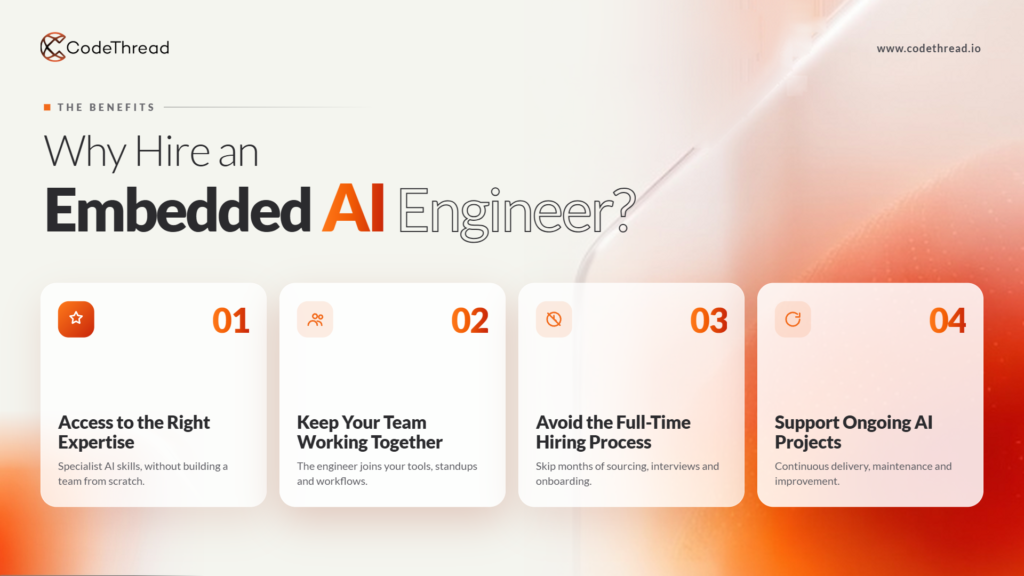
Your existing developers may be experienced in software development but have limited experience with AI agents, LLMs, or machine learning. By hiring a specialist, your team can receive the support they require without having to learn everything from scratch.
Working with a separate development company can sometimes create communication gaps, especially when the external team doesn’t fully understand your product.
It is much easier to communicate requirements, provide feedback, and resolve technical issues during development when the embedded engineer is on the same team as your developers.
It can take time to locate an experienced AI engineer. Businesses also need to consider salaries, benefits, recruitment, and onboarding.
For businesses that require expert advice but are not ready to make a long-term hire, an embedded engineering arrangement is an option.
AI development often continues after the first version is released. Businesses may need to improve an existing model, add new features, connect additional tools, or fix problems identified by users.
Having an engineer who understands the project can make this ongoing work easier to manage.
Both options can help a business develop AI solutions. The main difference is how the engineer joins the company and how the engagement is managed.
| Factor | Embedded AI Engineer | In-House AI Developer |
| Hiring model | Usually provided through an external engineering partner | Hired directly by the company |
| Team integration | Works alongside the existing team | Becomes a permanent employee |
| Recruitment | May offer a shorter route to accessing specialist skills | Requires the company’s own recruitment process |
| Cost | Often charged through a monthly engagement or agreed contract | Includes salary and employment-related costs |
| Flexibility | Can suit changing project requirements | Better suited to a permanent internal position |
| Best for | Businesses needing flexible access to AI expertise | Businesses building a long-term internal AI team |
Neither option is right for every business. If you need someone to work closely with your team on an ongoing AI project, an embedded engineer may be worth considering. If you need permanent internal ownership of your AI development, hiring directly may be the better choice.
You may benefit from an embedded AI engineer if your business has a clear reason to use AI but lacks the technical expertise to implement it.
For example, you might need additional support when:
Before hiring, be clear about what you want the engineer to accomplish. Define the project’s scope, the technologies involved, your budget, and how the engineer will work with your existing team.
It’s also worth reviewing their previous projects and asking how they approach testing, deployment, and ongoing maintenance.
Finding an AI engineer is one thing. Finding someone who can work with your existing team and understand your project is just as important.
CodeThread provides embedded AI engineering support for businesses that need experienced specialists to build and integrate AI solutions. Our engineers can contribute to AI product development, LLM integrations, RAG systems, and AI agent development while working with your existing team and tools.
Whether you’re developing a new AI product or adding AI capabilities to an existing application, the right engineering support can help you move forward without having to build an entire AI department first.
Need experienced AI engineering support? Explore CodeThread’s embedded AI engineers and book a free discovery call to discuss your project.
 maira asif
AI is transforming the way businesses operate, engage with customers, process data, and create new products. There are…
 maira asif
Learn how to choose the right AI development company by evaluating experience, AI development services, technical expertise, pricing,…
 maira asif
Explore the differences between generative AI and traditional AI, including use cases, benefits, limitations, and how businesses can…